


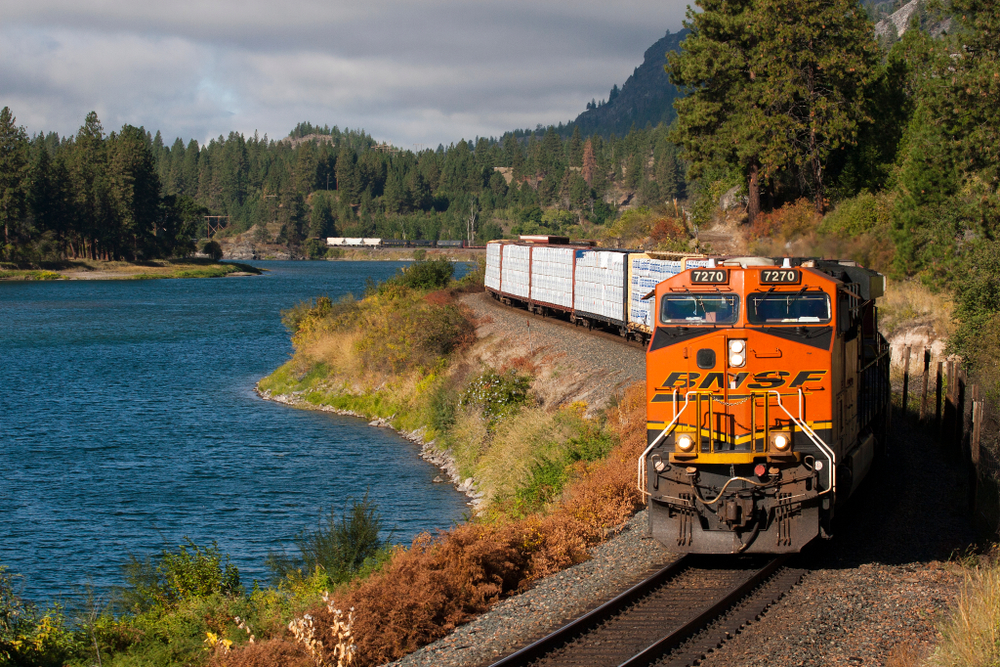
BNSF Railway is one of the largest freight railroads in North America. For over 175 years, the company and its predecessors have played an enormous role in the U.S. economy and growth. But BNSF’s legacy also includes decades of exposing its own workers and entire communities to asbestos, and the legal battles over its liability continue today. Many of the railroad’s employees, as well as people living near its rail yards or along routes where it transported asbestos, have been diagnosed with malignant mesothelioma, asbestos-related lung cancer, and other deadly diseases as a result of that exposure.
BNSF’s History
The company that is today known as BNSF Railway was formed in 1995 through the merger of Burlington Northern Inc. and Santa Fe Pacific Corporation, but its roots go back much further and involve many other railroad companies. Burlington Northern was the product of a 1970 consolidation of the Chicago, Burlington and Quincy Railroad — which was founded in Aurora, Illinois in 1849 — with the Great Northern and Northern Pacific Railroads. The Santa Fe Pacific Corporation’s roots trace back to 1859, when Cyrus K. Holliday founded the Atchison and Topeka Railroad Company. This grew into the Atchison, Topeka and Santa Fe Railway, which famously linked Chicago, Dallas, Los Angeles, San Francisco, and the Gulf of Mexico.[1]
Like all major railroads of that era, BNSF’s predecessor companies used asbestos extensively in locomotive insulation, brake systems, gaskets, floor tiles, pipe coverings, caboose stoves, and dozens of other applications. There is substantial evidence that the Association of American Railroads had been notified of asbestos toxicity as early as the mid-1930s, but the railroads continued using these materials for decades, exposing generations of workers to a known carcinogen without adequate warning or protection.[2]
In 2010, Berkshire Hathaway, the conglomerate led by Warren Buffett, acquired BNSF in a deal valued at roughly $44 billion. It became one of Berkshire’s largest and most profitable subsidiaries.[3]
How BNSF Workers Were Exposed to Asbestos
Asbestos was found throughout the railroad environment. Because it is inexpensive, durable, and highly resistant to heat and fire, it was used in virtually every area of the industry’s operations.
Asbestos-containing products used in railroad operations included:
- Pipe insulation and coverings
- Locomotive insulation and engine components
- Brake linings, brake shoes, and brake pads
- Clutch assemblies and gaskets
- Ceiling and wall insulation in passenger cars and cabooses
- Floor tiles
- Boilers and boiler cladding
- Asbestos rope used to heat rails
- Asbestos gloves and protective clothing
- Roof cement, sealants, and adhesives
- Welding materials and firebricks
When asbestos-containing materials are cut, bent, sanded, worn down through normal use, or in any other way manipulated or damaged, they release microscopic fibers into the air. Those fibers, once inhaled or ingested, can lodge permanently in the lungs or the mesothelium — the lining of the chest and abdominal cavities — where they cause scarring, cell mutations, and eventually cancer.
Who Was at Risk from BNSF Asbestos?
Railroad Employees
Almost every category of railroad worker faced some level of asbestos risk, including engineers, conductors, brakemen, firemen, mechanics, pipefitters, electricians, welders, insulators, trackmen, and section crew members. Even administrative railroad workers who spent time in older facilities were not immune. Studies have confirmed the danger: a 1999 study published in Occupational Medicine analyzing workers employed in railway carriage construction and repair found an excess of lung and pleural malignancies causally related to asbestos exposure.[4]
Workers responsible for building, maintaining, or repairing locomotives and rail cars faced the most direct and prolonged exposure. Mechanics who worked on brake systems and clutches were particularly at risk, as friction from worn parts generates fine dust. Any worker who handled, installed, or removed asbestos insulation — or who simply worked near others doing so — breathed in fibers on a regular basis throughout their careers.
Community Members Near Rail Yards
Exposure was not limited to railroad employees. In Libby, Montana — where BNSF and its predecessor companies transported asbestos-contaminated vermiculite insulation from the nearby W.R. Grace mine — entire communities were put at risk. Courts have been presented with evidence that 500 tons of asbestos-contaminated insulation moved through BNSF’s Libby rail yard every single day, and that contamination levels in and around the yard reached 150,000 times the EPA’s identified safe community exposure level.
The children of people who lived near the rail yard played in piles of vermiculite, and residents gardened with soil that had drifted from the yard. Today, their exposure to the unique form of asbestos known as Libby Amphibole has been linked to a particularly aggressive autoimmune disease of the lungs.[3]
Secondhand Asbestos Exposure to Railroad Workers’ Family Members
Family members of railroad employees also faced significant risk. Before the dangers of asbestos were widely understood, these workers came home every day with asbestos fibers clinging to their clothing, hair, and skin. Spouses who shook out and laundered those work clothes have been diagnosed with mesothelioma and other asbestos diseases decades later from this secondhand exposure, and the same is true of other family members, including the children of railroad workers, who simply shared a home with them.
Asbestos-Related Diseases Linked to BNSF Exposure
Exposure to asbestos — particularly over extended periods — can cause several serious and often fatal diseases. Because these illnesses have a latency period that can span 20 to 50 years or more, many former BNSF employees and Libby residents are only now receiving diagnoses related to exposures that occurred decades ago. These diseases include:
- Pleural mesothelioma — a cancer of the lining of the lungs caused almost exclusively by asbestos exposure
- Peritoneal mesothelioma — a cancer of the lining of the abdominal cavity
- Asbestos-related lung cancer — a cancer that starts in the lungs and is caused by exposure to asbestos
- Asbestosis — a chronic scarring of the lungs that impairs breathing
- Lamellar pleural thickening — a condition unique to Libby Amphibole exposure, causing layers of scar tissue that restrict lung function and is linked to autoimmune responses
- Chronic Obstructive Pulmonary Disease (COPD) — a chronic inflammatory lung condition that causes airflow obstruction and difficulty breathing
- Pleural plaques — areas of thickened tissue in the pleura around the lungs
Asbestos Lawsuits Against BNSF Railway
BNSF has faced — and continues to face — thousands of asbestos-related lawsuits filed by current and former employees, as well as from community members exposed to the carcinogen near its rail yards. The company has reported $359 million in environmental liabilities and expects asbestos claims to be filed against it through at least 2050.[3]
$8 Million Awarded to Two Libby Families
In 2024, a federal jury awarded $4 million each to the families of Joyce Walder and Thomas Wells, Libby, Montana residents who died of mesothelioma in 2020 after living near BNSF’s contaminated rail yard. The jury heard evidence that asbestos-contaminated vermiculite dust had blown from the company’s property into surrounding neighborhoods where the victims spent time. The jury agreed with the victims’ survivors that BNSF’s failure to contain or clean up the contamination was directly tied to their deaths.
Three Oregon Railroad Workers Sue Over Lung Disease
Three former BNSF employees — Charles Anderson, Harold Gjerman, and Gary Sachtjen — filed suit in Portland, Oregon, in 2015, asserting that their asbestos-related lung disease was caused by decades of working for BNSF and its predecessor, the Spokane, Portland and Seattle Railway. Each victim had worked in the industry for at least 34 years.[5]
Blommer v. BNSF: $5.24 Million for Former Great Northern Railway Worker
More than 50 years after leaving his job as an apprentice carman for the Great Northern Railway — a direct predecessor of BNSF —John M. Blommer was diagnosed with mesothelioma at the age of 78. He filed suit against BNSF Railroad, asserting that exposure to asbestos-containing insulation and parts was responsible for his illness. A jury awarded him $3.24 million for physical pain and another $2 million for mental anguish, for a total verdict of $5.24 million.
BNSF’s Environmental Impact and Superfund Obligations
In addition to the many people sickened by BNSF asbestos, the railroad company has also been blamed for having caused extensive environmental damage. Research found that transporting the carcinogenic material in open rail cars spread asbestos dust for miles along the rail corridors. The impact was so extensive that cleanup crews removed 800 dump-truck loads of contaminated soil from the area, and more than 2,600 private, public, and commercial structures underwent asbestos removal.
In 2020, the EPA, the Montana Department of Environmental Quality, and the U.S. Department of Justice signed a consent decree with BNSF in which the railroad agreed to take over the cleanup. The agreement addressed approximately 42 miles of right-of-way, rail lines, and rail yards in Libby and Troy, Montana, owned by BNSF.[6]
BNSF’s Approach to Asbestos Liability
Despite courts having repeatedly found that BNSF knowingly exposed people to asbestos, the company has pursued an aggressive legal strategy to limit its liability. Internal documents leaked by a whistleblower revealed that BNSF studied strategies to “positively impact payout filings” by forcing cases to trial rather than settling them. The company has refused to offer settlements to Libby residents impacted by their negligence, thereby forcing dying victims to go to court in order to get justice. In some instances, these victims have testified against the company on their deathbeds.[3]
Attorneys representing these victims say that this strategy has allowed BNSF to invest the reserves meant for asbestos victims instead of paying them out, and this has resulted in the company earning an average return rate exceeding 11 percent over twenty years of litigation. Advocates for victims say that this has meant hundreds of millions of dollars have been earned from funds that should have gone to victims and has created an incentive to continue delaying compensation as long as possible.
Were You Exposed to BNSF Asbestos?
Whether you are a community member who was sickened after having been exposed to asbestos from BNSF rail yards or you worked for BNSF Railway or one of its predecessor railroads, you may have legal options. While some may pursue personal injury or wrongful death claims, railroad workers who have been diagnosed with mesothelioma or another asbestos-related disease may be eligible to pursue claims through the Federal Employers’ Liability Act (FELA), which allows injured railway employees to seek compensation for injuries suffered on the job, including asbestos-related illnesses. FELA claims require proof of employer negligence, but can provide compensation for medical expenses, lost wages, pain and suffering, and disability.
An experienced mesothelioma attorney can evaluate your case and provide you with guidance about the options available to you based on the specifics of your situation. It’s important that you act quickly after your diagnosis, because statutes of limitations exist on asbestos-related claims, and delay can lead to your being unable to pursue justice.
References
View All References